
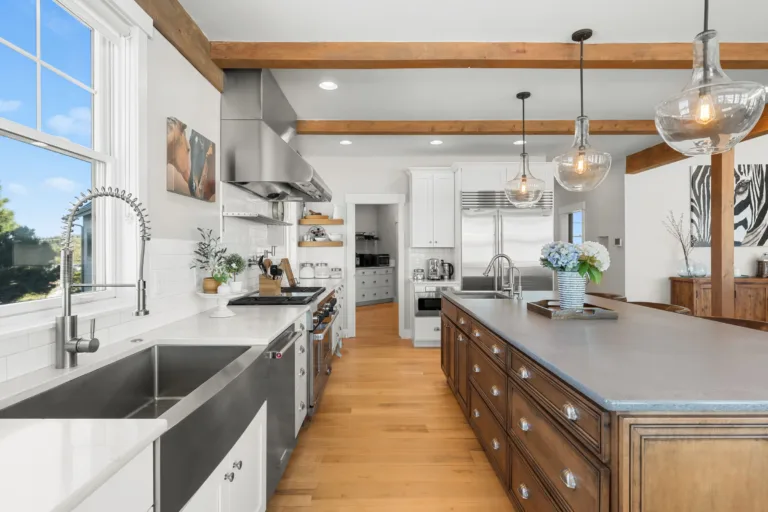
The Complete Guide to Custom Kitchen Design: Layouts, Finishes, and Luxury Details
Designing a custom kitchen is one of the most exciting parts of building a custom home… Aaand one of the most overwhelming. It’s the room where more decisions stack up than anywhere else in the house. Cabinets, countertops, layout, appliances, lighting, hardware, storage, flow. Each one matters, and they all have to work together. Get it right, and your kitchen becomes the heart of your home. Get it wrong, and you’ll feel it every single day.
The good news? You don’t need to hire a professional kitchen designer to get a stunning, functional result. All you need is a solid understanding of the principles, a clear process, and the right builder walking alongside you. This guide gives you all of that. Whether this is your first time designing a kitchen from scratch or you’ve done it before and want to go deeper — read this start to finish. Save this post, you’ll want to come back to it.
Looking for Something in Particular?
- Start Here: The Fundamentals of Kitchen Design
- Kitchen Layouts: Which One Is Right for Your Custom Home?
- Kitchen Finishes: Building a Palette That Lasts
- 6 Common Kitchen Design Mistakes (And How to Avoid Them)
- Subtle Luxury Details That Elevate a Custom Kitchen
- How to Plan an Organized, Beautiful Kitchen Without a Professional Designer
Start Here: The Fundamentals of Kitchen Design
Before you pick a single cabinet door style or fall in love with a particular countertop slab, you need to understand what makes a kitchen actually work. Beautiful kitchens that are frustrating to cook in are more common than you’d think — and they almost always trace back to ignoring the fundamentals.
The Kitchen Work Triangle
The kitchen work triangle is the foundational concept of kitchen design, developed by architects in the mid-20th century and still just as relevant today. The idea is simple: your three primary work stations — the refrigerator, the sink, and the cooktop — form a triangle, and that triangle should allow you to move efficiently between all three without obstruction. Each leg of the triangle should ideally be between 4 and 9 feet. Too short and you’re constantly bumping into things; too long and you’re doing laps every time you cook.
In modern kitchens — especially open-concept designs common in custom homes — the triangle has evolved into a broader concept of “work zones.” You may have a prep zone, a cooking zone, a cleanup zone, and even a beverage or coffee station. The principle stays the same: think about how you actually move through a kitchen when you’re cooking, and design the space to support that movement, not fight it.
Function Before Beauty
This sounds obvious, but it’s the rule most homeowners break first. They see a kitchen they love on Pinterest, fall in love with the aesthetic, and try to retrofit their real-life habits into it. Start instead by asking yourself honest questions:
- How many people cook at the same time in your household?
- Do you bake seriously, or is the oven mostly for reheating?
- Do you meal prep in large batches, or cook fresh daily?
- How much do you entertain, and does the kitchen need to handle guests?
- Do you have kids who will use the kitchen independently?
Your answers to these questions should drive your layout decisions, your storage priorities, and even your countertop height choices before aesthetics ever enter the conversation. A kitchen designed around your actual life will always outperform one designed around a photo.
Kitchen Layouts: Which One Is Right for Your Custom Home?
One of the biggest advantages of a custom kitchen — as opposed to buying an existing home — is that you’re not inheriting someone else’s layout choices. You can design the configuration that fits your lifestyle and your floor plan from the start. Here are the most common layouts and when each one makes sense.
The L-Shape
The L-shape runs cabinets and counters along two adjacent walls, forming an L. It’s one of the most versatile layouts available, working well in both small and large kitchens. It naturally creates an efficient work triangle, keeps traffic out of the main work zone, and opens up the rest of the room for a dining table or island. If you’re building an open-concept great room and want your kitchen to flow into a living or dining space, the L-shape is a natural fit.
The U-Shape
The U-shape wraps cabinetry and countertops along three walls, giving you maximum storage and counter space. It works beautifully in dedicated kitchen rooms — not so well in completely open floor plans where one wall is essentially an opening.
The U-shape is the dream layout for serious home cooks who want space to spread out, because you can have everything within arm’s reach without the layout feeling crowded. The one thing to watch: the width of the center corridor. You want at least 5 feet between opposing counters for two people to work comfortably.
The Galley
Two parallel runs of cabinetry facing each other — the galley is compact, efficient, and often underestimated. It’s the layout of choice in professional kitchens for good reason: everything is within a step or two. In a custom home, a galley-style kitchen can feel sleek and intentional when designed well, particularly in more contemporary or minimalist builds. It works best as a dedicated kitchen space with clear openings at each end.
The Island Layout
More of an addition than a standalone layout, the kitchen island has become a staple in custom home builds — and for good reason. An island adds prep space, seating, storage, and a natural gathering point all in one.
It pairs beautifully with L-shaped and U-shaped layouts. The key is making sure you have enough clearance: at least 42 inches on all sides of the island for a single-cook kitchen, 48 inches if two or more people will be working at once. An island that’s too large for the room creates more problems than it solves.
The One-Wall Kitchen
Less common in custom builds but worth knowing: all cabinetry and appliances run along a single wall. This layout works in very open floor plans or smaller homes where you want a minimal kitchen footprint. It’s also a great approach for secondary kitchens — think a bar area, a pool house, or a basement entertaining space.
Kitchen Finishes: Building a Palette That Lasts
Finishes are where your kitchen’s personality comes to life — and where most homeowners spend the majority of their decision-making energy. The secret to a kitchen that looks intentional rather than random is understanding how to build a cohesive finish palette. Think of it like a pyramid: your biggest surfaces set the tone, and your smaller accents complement them.
Cabinetry
Your cabinets cover more square footage than any other element in the kitchen. That makes them your most important design decision. A few things to work through:
Style: Shaker cabinets are the current standard for a reason — they’re clean, versatile, and work across traditional, transitional, and even moderately contemporary kitchens. Flat-front (slab) cabinets lean more modern. Inset cabinets, where the door sits flush with the cabinet frame, are the hallmark of true custom cabinetry and have a refined, furniture-like quality that’s worth the premium.
Finish: Painted cabinets dominate the custom home market right now. White and off-white remain classics. Greens, blues, and warm greiges have become popular choices for lower cabinets or islands paired with white uppers. Natural wood cabinets — white oak, walnut, and cerused finishes — are having a serious resurgence, particularly in transitional and organic-modern builds.
Construction: In a custom home, you have the opportunity to specify truly custom cabinetry built to your exact dimensions — not stock or semi-custom boxes. This matters more than most people realize. Custom cabinet boxes allow you to maximize every inch of your kitchen, eliminate awkward filler strips, and get interior organization that’s built for how you actually live.
Countertops
Countertops are the workhorse surface of your kitchen, so durability and maintenance behavior matter just as much as looks. Your main options in a custom kitchen build:
Quartz
is engineered stone — durable, non-porous, and nearly maintenance-free. It doesn’t need to be sealed and holds up well against stains. The tradeoff: it can look less unique than natural stone, though higher-end quartz has improved dramatically.
Quartzite and granite
are natural stones with genuine uniqueness — no two slabs are identical. They’re incredibly hard and heat-resistant. They do require periodic sealing and can be susceptible to staining if neglected. For homeowners who love natural variation and are willing to do basic maintenance, natural stone is hard to beat.
Marble
is the timeless choice for kitchens that lean elegant and traditional. It’s also the most high-maintenance — it etches, stains, and scratches more readily than other options. That said, many homeowners who choose marble embrace the patina it develops over time. If you’re a serious cook who uses your kitchen hard, be clear-eyed about this before committing.
Soapstone and leathered finishes are worth knowing about for homeowners who want something less common. Soapstone is virtually non-porous, develops a beautiful matte patina, and has a soft, organic feel. Leathered granite or quartzite has a textured matte surface that hides fingerprints and minor imperfections better than polished alternatives.
Backsplash
Your backsplash is the ideal place to introduce texture, pattern, or color without overcommitting to it. In a custom kitchen, you have far more flexibility here than in a production build. A few directions that tend to photograph well and age gracefully:
- Subway tile is the classic, and it works — especially in handmade or unlacquered finishes that have natural variation
- Slab backsplash (the same stone as your countertop running up the wall) reads as elevated and seamless
- Zellige tile — handmade Moroccan tile with organic variation in glaze and shape — adds texture and warmth without loud color
- Unlacquered brass or matte plaster behind a range hood can create a beautiful focal moment in the right kitchen
Flooring
In a custom home, your kitchen floor often flows from your main living areas, so it shouldn’t be considered in isolation. Wide-plank hardwood is the perennial choice for warm, transitional, and traditional kitchens. Large-format tile — 24×24 or larger — works well in contemporary or Mediterranean-influenced spaces and is highly practical. If you have radiant floor heating (which is an excellent addition in Colorado’s climate), tile or stone is the most efficient choice.
6 Common Kitchen Design Mistakes (And How to Avoid Them)
Even with the best intentions, certain mistakes come up again and again in custom kitchen design. Knowing what they are puts you ahead of most homeowners who only discover them after move-in.
Not enough storage
The number one complaint of homeowners one year into a new kitchen. Everyone underestimates how much storage a functional kitchen requires. Go deep with your planning here — pull-out shelves in lower cabinets, a dedicated pantry or walk-in pantry if your floor plan allows, appliance garages to keep counters clear, and vertical storage that reaches the ceiling.
Too little countertop on the wrong side
Pay attention to which side of your sink and cooktop you’ll be setting things down. Most right-handed cooks naturally want landing space to the right of their range and on both sides of their sink. Sketch out your workflow before finalizing your layout.
Ignoring the refrigerator swing
The direction your refrigerator door opens matters a lot depending on where it sits in the layout. This gets overlooked in drawings and becomes a daily frustration in real life.
Underplanning the lighting
Most kitchens have one overhead fixture and call it done. A well-lit custom kitchen has multiple layers: recessed cans for general illumination, under-cabinet lighting for task work, pendants over the island for ambiance and visual interest, and often a statement fixture over a dining area. Plan your lighting on its own circuit diagram early — not as an afterthought.
Matching everything
Perfectly matched cabinets, countertops, hardware, and appliances can feel flat and manufactured. The best custom kitchens have intentional contrast — light upper cabinets with a warmer wood island, unlacquered brass hardware against matte white, a bold range hood against quiet cabinetry. Contrast creates depth.
Skipping a dedicated prep sink
If your kitchen is large enough, a small secondary sink on the island or in a prep area is one of those things you’ll use every single day and wonder how you ever lived without.
Subtle Luxury Details That Elevate a Custom Kitchen
This is where a custom kitchen separates itself from anything you’d find in a production home. These aren’t flashy additions — they’re quiet details that experienced eyes recognize and that make daily life genuinely better.
Inset cabinetry
As mentioned earlier, inset doors sit flush with the cabinet frame rather than overlaying it. It’s a hallmark of traditional American craftsmanship and immediately reads as custom-built. Paired with quality hinges, the result is a kitchen that feels like furniture.
Integrated appliances
Paneled refrigerators and dishwashers — where the appliance face is covered with a cabinet panel to match your cabinetry — create a seamless, built-in look. It’s particularly effective in transitional and traditional kitchens where you want the appliances to disappear into the design.
Unlacquered brass hardware
Brass hardware has made a full comeback, and for good reason — it adds warmth and depth that brushed nickel and chrome simply don’t. Unlacquered (as opposed to lacquered) brass develops a natural patina over time, which many homeowners find more beautiful than hardware that stays perfectly shiny.
A statement range hood
Your range hood is often the most prominent architectural element in the kitchen. A custom plaster, shiplap, or wood hood — rather than a standard metal insert — makes a dramatic difference. It becomes the visual anchor of the space.
Quartersawn or rift-sawn white oak
If you’re doing any natural wood in your kitchen, ask about cut. Quartersawn and rift-sawn cuts produce a linear, consistent grain pattern that’s more stable and more architecturally refined than the typical cathedral grain of plain-sawn lumber.
Thoughtful interior organization
Drawer inserts for utensils, pull-out spice racks beside the range, peg systems for dishes, custom dividers for baking sheets — these are the details that don’t show in photographs but determine how enjoyable your kitchen is every single day. In a custom build, this can all be designed in from the start.
Toe-kick lighting
A subtle strip of LED lighting at the base of your lower cabinets creates a floating effect at night and serves as practical nighttime illumination. It’s an unexpected touch that feels immediately elevated.
Appliance garages
A dedicated cabinet with a lift-up or roll-up door that conceals your toaster, coffee maker, or stand mixer keeps your counters perpetually clear. When closed, it looks like just another cabinet. When open, everything is accessible without taking up permanent counter real estate.
How to Plan an Organized, Beautiful Kitchen Without a Professional Designer
The secret most designers won’t tell you: the principles behind a great kitchen aren’t proprietary knowledge. They’re learnable. Here’s the framework.
Build a visual library first. Before you make a single selection, spend time saving images of kitchens you love. Use Pinterest, Houzz, Architectural Digest, and Instagram. After 50–100 saves, look for the patterns. Are you consistently drawn to light kitchens or dark ones? Warm tones or cool? Minimal hardware or decorative? Natural materials or painted finishes? Your recurring preferences will tell you more about your design direction than any personality quiz.
Establish your anchor. Choose one element to anchor your design — usually your countertop slab or your cabinet color — and build everything else around it. This prevents the common mistake of selecting pieces you love individually that don’t work together.
Follow the 60-30-10 rule. Apply your dominant finish (60%) — typically your cabinets — then your secondary finish (30%) — usually your countertops and backsplash — then your accent (10%) — hardware, fixtures, and decorative elements. This ratio creates visual balance without making the space feel monotonous.
Order samples and live with them. Cabinet paint colors look different on a large door than on a 2-inch chip. Stone slabs photograph completely differently than they look in person. Whenever possible, get physical samples and look at them in your actual space under natural light at different times of day before committing.
Think in layers. A kitchen that photographs beautifully and feels beautiful to live in has multiple layers — texture, warmth, light, and contrast all working together. Flat kitchens with no variation in tone or texture feel sterile. Add texture through tile, wood, woven pendants, or open shelving. Add warmth through wood accents, warm lighting, and organic materials. Add depth through contrast.
Building Your Dream Kitchen with Canaan Homes
Designing a custom kitchen from scratch is a deeply personal process — and it goes best when you have a builder who treats it that way. If you’re in the early stages of planning a custom home — or even if you’re just starting to research what’s possible — we’d love to have a conversation.
Get in Touch with Canaan Homes →
And if you’re not quite there yet? Save this guide. Come back to it when the time is right. The best custom kitchen builds start long before anyone breaks ground — they start with homeowners who’ve done their homework and know what they want. You’re already on your way.
